|
||||


 |
Media now the key portal for politicians to acccss power, Sen. Bennett says By
Heather Wardle
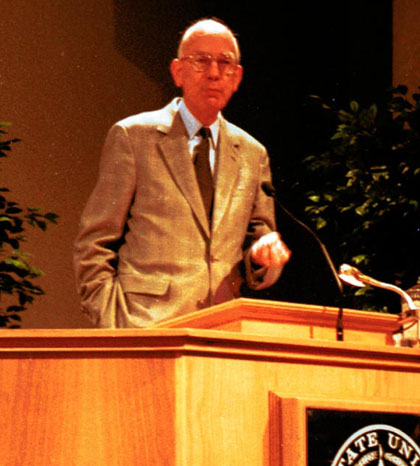
Sen. Bob Bennett tells USU students that he opposes campaign finance changes that would limit what he can spend on media. / Photo by Michael Hamblin "America's source of power is its people, so what role does the media take?" This was the issue at hand, as U.S. Sen. Robert Bennett, R-Utah, addressed students as the final speaker for the Journalism and Communication Department's Media & Societies Lectures. Professor Ted Pease introduced Bennett as one of "his favorite Utah senators," and Bennett quickly responded saying, "you had a fifty-fifty chance." After a brief introduction, Bennett was down to business. "The No. 1 issue in Washington with respect to the media, " Bennett said, "is how we deal with campaigns." He gave the example of U.S. Sen. and presidential candidate John McCain, and the way in which he established a "base," generated by the media. "For a while," Bennett said, "it almost looked like he would ride it [the media] all the way through to nomination." If he had, it would have been the first time in history that any candidate had successfully used the media to do that. Bennett told students that media have taken a more powerful, more significant role than had been envisioned by the framers of the Constitution, because it has become almost impossible to access the people without some type of media. Bennett said, "The media then becomes the portal for which one must access power. "Politicians are not the source of power; people are. And I can't become a politician until I gain access to people, and access to people is through media." Bennett spoke about the two ways in which politicians were able to obtain media access. The first is "earned" media, meaning free media. Bennett told students these were things like "Meet the Press, or Take Two with [TV reporter] Rod Decker." Bennett shared an experience with an actual interview he had with Decker. When he asked how many were watching, Decker responded, half-jokingly, "less every minute," but later admitted there were probably somewhere around 50,000 watchers. Bennett pointed out the significance of being able to reach that many people in one time. However, he noted that earned media had i's downfalls, as it is usually the press who set the agenda and not the person seeking office. The second type of media Bennett referred to as paid media. These included paid advertisements, which Bennett said allowed him to "say whatever he want." Yet, it too has its downfalls, and claimed the media limits power to buy an ad, such as preventing the purchase of half-hour blocks of time in the evening, and thus, making him more dependant on earned media. In closing Bennett spoke strongly of what he called a "falsity." He said many assume that when he runs an ad, he is competing with his opponent. Bennett said however, that in fact, he was competing with Mercedes, and the Budweiser frogs and other channels of TV. "If I'm on free air time with an opponent, I'm competing with Who Wants to Be a Millionaire, or the Jazz game, and If I want someone to watch then I have to buy an ad during a Jazz game. "You're not just competing with your opponent," he said, "but all the other messages people are receiving."
|
Archived Months:
January
1999 January
2000 |
||