|
||||||||||


 |
Experience is best teacher for CHEC Systems users, even if it means burning fabric or making a 'barf bag' By
Leah L. Culler
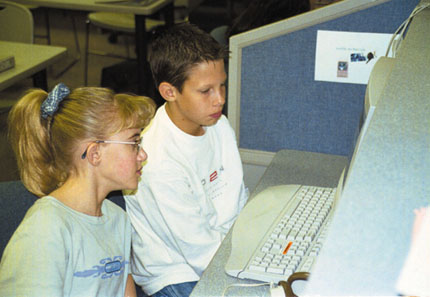
Ehrhart said she likes the CHEC curriculum because it lets students work on their own. Students work in pairs on different modules, and work at their own pace. Because the computers the students work on are all linked to a network, Ehrhart can monitor the students' progress and give them immediate feedback. She can watch them take tests on the computer and send messages to an individual student or to the class as a whole. "The classroom is easy to manage," she said. "And the children enjoy what they're doing." Because the students work in pairs and rotate every few days, the program provides a good social experience too, Ehrhart said. Ehrhart said the school looked at CHEC's competition when deciding on career exploration software, and CHEC was the best option. "It was attractive to have technicians here in Logan," she said. "And the hands-on activities weren't as good in the other programs." If students finish the day's work early, CHEC has incorporated links to related Web sites the students can go to and learn more about the day's topic. Ehrhart said the students do CHEC modules about two days a week, while other time is spent on other family and consumer science activities. Ehrhart is only one of the many teachers in 38 states who have CHEC curriculum in their classrooms. And, according to Robinson, most teachers who see CHEC labs want them in their schools as well. But how did such a change in teaching method come about? According to Robinson, the idea originated at Utah State University. A group of educators saw the need for this type of life management curriculum. Robinson's neighbor, Jan Preston, was a part of the original company, which was owned by the Utah State Board of Education. Preston got Robinson involved and Robinson worked as the director of marketing from 1979 to 1984 and helped to develop a market outside of Utah for the product. Robinson purchased the marketing rights to CHEC in 1984 and the copyright to the company in 1994. Robinson's wife, Julie, said it was frightening for her when her husband decided to buy CHEC Systems. "He was taking on a financial responsibility that was scary to me," she said. "I was thinking of safe and secure." Julie Robinson now helps in bookkeeping, and all of her children have had some involvement in the company. "It's been good for the family," she said. "We've all had involvement and learned skills." Two of Greg Robinson's sons now work for him. His son Tim is currently the marketing director, while Brad works in accounting. "The education system tries to get things as cheaply as possible. They cut out things like training. That's like giving a Mercedes to a 10-year-old." Tim Robinson said he started sweeping the floors and dumping the garbage cans at CHEC when he was in high school. He attended college and studied marketing but wasn't sure what he wanted to do. He said he recognized a great opportunity at CHEC and "decided to stick around." Greg Robinson said it is challenging at times to work with his sons. "Sometimes they don't see you as the boss," he said, "but they're very loyal." Julie Robinson said she thinks CHEC is a great company. "I believe in strong family values," she said. "It's a company that promotes family values and strengthens the home. If it helps support strong families, it's a good thing." Greg Robinson said one criticism of CHEC is that many of the 55 modules are vocational jobs such as a building maintenance worker or a dry cleaner, and "no one wants to have those jobs." But he said students need to learn about these type of careers so they can support themselves while gaining an education for other careers. "It's also nice to know whether you like to work with people before you get in that situation," he said. "You need to learn skills about (things like) how to be on time and have manners." Tim Robinson said these career exploration modules focus on areas of life skills and life management. "I'm really excited because what we're trying to do as a company is teach kids to become better adults," he said. Cutler said family and consumer sciences are gaining more and more attention, respect and credibility. "There was a time when people put all their attention on computer technologies," she said. "They soon realized students were missing life skills." Cutler said she likes her job because it is such an important field. "You feel like you're really contributing to something important," she said. Greg Robinson also loves his job and said it's been a fun career. "It's a new method of learning," he said. "The teacher becomes the facilitator." Teachers have to know a great deal in order to facilitate, however. All schools with CHEC labs have mandatory teacher training for the first year, Greg Robinson said. He said it's essential that teachers learn about CHEC before trying to integrate it into a classroom. "The education system tries to get things as cheaply as possible," he said. "They cut out things like training. That's like giving a Mercedes to a 10-year-old. You just don't do it." He said the emphasis on training puts a huge stress on CHEC. "It's an ongoing thing," he said. "We do a lot of training and support." Training is the main job for Inservice Coordinator Mary Chapman, who works out of the Georgia office. CHEC put an office in Georgia because it was one of the first states to adopt the CHEC program statewide, Greg Robinson said. Chapman said she does trainings about once a month and spends the rest of her time visiting classrooms and supporting training that has already been done. Four teachers from across the country were in Logan March 2 through 4 for a teacher training. The teachers were training to facilitate another curriculum CHEC produces, designed for students in grades nine through 12. This curriculum focuses on life management and includes modules such as an introduction to work and family, home security, healthy lifestyles and money and credit. The curriculum consists of 17 modules and is designed to instruct students in the art and science of balancing work and the family through the use of technology. These modules are more in-depth, designed to take six days each. The teachers at the training session had a difficult time getting used to the curriculum. "This is major learning for me," said Belinda Buehler from Yakima, Wash. "Younger people are more used to working on the computer and I'm counting on the fact that the kids are going to pick up on it." Buehler said she was excited about the program, however. "If I were a kid, I would prefer learning on a computer rather than sitting in a class listening to a lecture," she said. "I like how it has you go do activities." D'Nelle Lyons from Richardson, Texas said she is a little worried about learning the curriculum and teaching it to her students. She said she knew her students would enjoy the modules, however. According to Lyons, her school chose CHEC systems because it was more hands-on than similar curriculum in the industry. "The others were not geared for senior high," said Sharon Kester from Jerome, Idaho. All the teachers said they enjoyed working through the modules and knew their students would as well. Chapman said it is important for the teachers to work through a module with the class as a whole first to teach the procedure and content of the material. She said students would have to learn how to follow directions instead of just assuming how to do things. "It's human nature to just try and go through something," she said. "They will be learning very specifically how to follow directions." Students in a CHEC classroom are self-motivated and learn how to work on their own, Greg Robinson said. The students take the supplies for the exercise, all stored in individual 12- by-18 inch drawers in a 4-by-4-by-2 foot wheeled cart, to their workstations to complete the exercise. Supplies for a module range from video tapes and books to digital cameras, weaving looms and rubbing alcohol. The supplies are purchased in bulk by CHEC and packaged together by module in their warehouse. "Everything that goes together is there for the teacher to teach except perishable food items," Greg Robinson said. Warehouse supervisor Russ Crescentini takes care of production and inventory, as well as making deliveries across the country. The warehouse is several miles from CHEC's business office, and Crescentini likes it that way. "Nobody bothers me down here," he said. "It's different, it's kind of a solitary job." But Greg Robinson said the warehouse and office will soon be in one place. The company has purchased a plot of land near the Crystal Inn at the south end of Logan and plans to complete construction within the next year or so. Even Crescentini is excited for the move. "It will be nice to get everybody in one area," Crescentini said. "It would really help the company." And, according to Greg Robinson, the company's just getting started.
He said it has seen a large increase in business over the last couple
of years and he expects things to continue to get better. Someday, he
said he hopes to see CHEC labs, like the one at Mount Logan, in schools
in every state. |
Archived Months:
January
1999 January
2000 |
||||||||