|
||||


 |
Starry, starry night: Thanks to clear nights of Utah, laser gathers global warming data dozens of miles up By
Rosanne Radcliffe
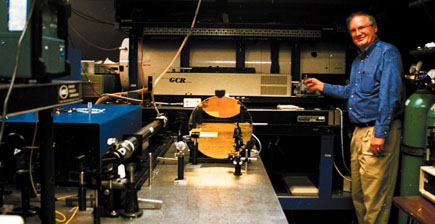
Dr. Vincent Wickwar shows off the device at USU that creates a green laser beam to study the middle section of the atmosphere. / Photo by Michael Hamblin Editor's note: This story was written for Comm 3110, "Beyond the Inverted Pyramid," an advanced news-feature writing class in the USU department of journalism and communication. No, it's not a prop for another Star Wars movie or the hint of a free laser-light show. The green beam of light you may notice shooting into the sky on a starry night on Utah State's campus measures the temperatures of the middle atmosphere, and Logan is just the place to do it. The Atmospheric Lidar Observatory (ALO) at Utah State uses the laser to study the mesosphere. Dr. Vincent Wickwar, a USU physics professor, said the project's purpose is to understand the importance of the detailed and average behavior of the temperatures in the middle atmosphere. It is so important, if fact, that the ALO is paid by the National Science Foundation (NSF) to run this high-tech research project. "We are looking at the physics of it all so in the long run we can help in the study of global warming," said Wickwar, who studies aeronomy, a mixture of physics and chemistry that describes the study of the mesosphere, said. Researchers have a couple of key questions about global warming. "When you can see the stars, that's when we get through with the laser. Can you imagine doing this in Seattle?" "The first is the question of whether it's real or not," Wickwar said. "The second is whether it is a natural cycle that's going on or is it something we've caused." Wickwar said that people assume that the problem with global warming is based on carbon dioxide. "What we do know is that levels of carbon dioxide in the mesosphere are increasing," he said. "But we don't know how to accurately relate the CO2 (carbon dioxide) to the earth's temperatures." The national consensus is that the earth's temperatures are increasing, but Wickwar said even that is a hard determination to make. In the long run, he said the green beam could tell the effect carbon dioxide and other green house gases have on the mesosphere's temperatures. It is predicted to be as much as 10 times higher than the temperature in the lower atmosphere. "Right now we don't have any long-term measurements of temperature that one can say aren't affected by things happening around us," he said. He said there are several complications in measuring such temperatures because of the earth's natural cycles. For example, volcanic eruptions in the past have had an effect of the temperature of the mesosphere, such as the eruption of Mount Pinatubo in the Philippines in June 1991. The National Center for Atmospheric Research in Bolder, Colo., is making model calculations of how carbon dioxide relates to the earth's temperatures for the research of global warming. Wickwar said if there is an increase in temperature in the lower atmosphere, then that may produce more clouds, which would in turn reflect more sunlight into space reducing the light hitting the earth. However, this increase of carbon dioxide located in the mesosphere is radiated into space and cooled down. He said the carbon dioxide molecules would run into nitrogen and oxygen molecules, cooling those as well. Wickwar said this procedure of measuring the mesosphere's temperature with the lidar, in relation to the temperature of the troposphere (lower atmosphere) is more sensitive than the Boulder model. The lidar (light detection and ranging) is a radar device that consists primarily of a powerful laser called Nd:YAG, the name of the crystal that works inside of the laser, but also identifies the laser itself. The crystal is "pumped" into its upper state by flash lamps, which are like the electric flash on your camera, he said. "We put a bright light in the laser, then it charges the crystal, which then emits the light that goes into the sky," Wickwar said. The mesosphere is about 50 to 90 kilometers up from mean sea level, about 30 to 55 miles. The telescope is 44 centimeters in diameter. It is combined with a sensitive detector (photomultiplier tube, or PMT) to measure the laser light that is scattered back from the sky. Every one-thirtieth of a second, Wickwar said the ALO group send a seven nanosecond-long pulse - a nanosecond being one-billionth of a second - of green light into the mesosphere. From the moment it is sent up and stops seven nanoseconds later the length of that pulse measures 8 feet long. The light hits nitrogen and oxygen molecules that scatter it in all directions. The repetition rate of the laser is fast enough that our eyes see a continuous beam of light. However, if you move your head quickly from side to side while watching the beam, the beams are distinct and apparent. Wickwar said we see the beam because a very small portion of the light is scattered off the molecules in the atmosphere, mostly nitrogen. The weak scattering of light, referred to as Rayleigh scattering, is the same process that makes the sky appear blue and makes the sun or moon appear orange when on the horizon. If there is more light being sent by the beam into the mesosphere from a bigger telescope, Wickwar said the better and more accurate the readings will be from detecting that light. Therefore, the ALO is building a bigger telescope. It will consist of four mirrors, allowing a bigger signal to be detected. This process will in turn provide more accurate readings of the mesosphere's temperatures. Wickwar said the new telescope would be thirty times the size of the old one the ALO is using. He said the new telescope would improve the work the ALO is doing now with the smaller laser, in three specific ways. The first is that it will give them more precise readings, which is most important in studying high altitudes. The higher the altitude, the more uncertainty there is in the readings. Second, with a bigger telescope, the ALO group can receive readings within plus or minus five degrees of the actual temperature of the mesosphere instead of plus or minus 30. They will also be able to go to higher altitudes. Instead of 90 kilometers, Wickwar said they could take signals at 115 kilometers. A third improvement that will be made is reducing the time it takes to receive the readings. Graduate student Josh Herron, who is working on his masters and writing his thesis involving the operation of the laser and the temperatures derived from it, said, "In principle, what takes us one hour now will take us two minutes a few months from now." Wickwar said he hopes to have the new telescope about three months from now. Back in 1991, Wickwar said the CASS (Center for Atmospheric and Space Sciences) lidar group began assembling the lidar components and trying to make the laser work. It wasn't until 1993 that the ALO started to make actual observations of the mesosphere. Wickwar said the lidar group is copying the techniques of French woman Marie-Lise Chanin, who began her research in 1978. She was the first person to make regular observations of the middle atmosphere using a Rayleigh-scatter lidar. The approach Chanin took in France and that ALO is taking today involves making as many observations as possible on every clear night so they can look for the average behavior of temperatures at certain altitudes. This provides a baseline for more detailed studies of the mesosphere. "A long time ago the mesosphere was called the 'ignoreosphere' because it was hard to measure without the proper equipment," Wickwar said. "Since the mid-1970's, we began to receive good measurements from our equipment. We are also trying to push technology to get more information from these measurements and try to validate that what we're doing is correct." Assisting Dr. Wickwar with the ALO lidar project are six undergraduate and one graduate student. Herron and a physics major are currently working on data reduction and the analysis and interpretation of the readings. Two engineering majors work more specifically with the electrical and mechanical procedures of the project. Two other students are working toward their teaching certificates to teach high school physics and chemistry. Wickwar said they primarily work on tours, displays, and other forms of information to educate others about the lidar project. A computer science major is involved with the computer-programming portion of their work. "Although everyone is assigned to work on a particular area of work, they are all involved in the observing," Wickwar said. "And they do have to be there to collect the data. If something were to go wrong, someone needs to be there." Financially, the ALO is funded by NSF, the federal agency that funds most of the non-medical basic research projects in the country. NSF's annual budget, Wickwar said, is almost $4 billion. "They support all major universities," Wickwar said, "so that is very little money supporting an awful lot of people." He said when he was there 20 years ago, the NSF's annual budget was $2 billion. "The problem is," Wickwar said, "the grants NSF give out are constant and the cost of scientific research keeps going up." On another matter, Wickwar said being up at 5,000 feet is a good thing. He said USU's campus in Logan is a great place to run this project because it is a nice location and the technique works well here in the high altitude and the high percentage of clear air - in relation to the rest of the United States. Wickwar said he and the other ALO employees try to operate the laser every clear night they can because cloudy nights can affect the magnitude, or the power, of the signal. The lidar group runs the laser at night because the weak beam of light is easy to separate from the moonlight and the city lights. He said during the day there is so much light that there would be too much scattering and the beam of light could not be separated from the sunlight. "The technique to observe the mesosphere with the laser beam during the day does actually exist," Wickwar said. "A group on the coast of Norway called ALOMAR (arctic lidar observatory for middle atmospheric research) measures day and night temperatures quite nicely by creating a narrow enough filter. We have those techniques, we just aren't funded for it." Because of the clear nights, Wickwar said Logan is such a good place for lidar research. "It is a nice high altitude instead of the muck of the East Coast or the L.A. Basin," he said. "There are a lot of clear weather nights here compared with the rest of the United States. When you can see the stars, that's when we get through with the laser. "Can you imagine doing this in Seattle?"
|
Archived Months:
January
1999 January
2000 |
||