|
Hyrum's historical treasure includes Ted Kindred
 |
WELCOME
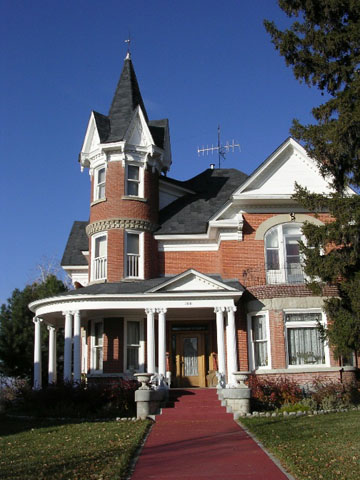
TO OUR HISTORY: Ted Kindred's 100-year-old
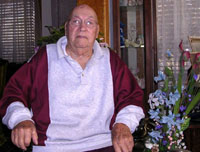
Hyrum house is nearly a museum in itself. Below
is Kindred himself in his living room. / Photos
by Heather Williams
|
By Heather Williams
November 18, 2004 | HYRUM -- "You
have to do it yourself or it doesn't happen," is the
advice of longtime Hyrum resident Ted Kindred.
Kindred has been a resident of Hyrum for 45 years.
Kindred has been the driving force behind a number of
changes in Hyrum. He said at one point he became concerned
that the city never did anything for teenagers. He said
that teenagers are the ones who need the attention.
So one day he and his wife drove around and rounded
up close to 30 kids and their skateboards, and took
them to the City Council meeting. He said they wanted
a skateboarding park. As a result they reserved a corner
of the rodeo grounds to be a skateboarding park.
"It was the first one in the valley," Kindred said,
smiling.
This is just one example of the things Kindred does
to try and improve the community and have his voice
heard. Another example: for years he fought for a park
on the west side of Hyrum. He said everything was on
the east, but now they're getting a park on the west
called the Salt Hollow park.
Kindred is originally from Iowa. He worked for Solar
Aircraft in Des Moines, but Solar Aircraft closed its
doors in Iowa and moved to California. Kindred said
he didn't want to move to California. A friend of his
told him of Thiokol in Promontory, Utah. "I was fascinated,"
Kindred said of the 3-D machining used by Thiokol. He
was so fascinated that he and his wife and six children
moved to Utah.
"It was very hard to find housing at the time," Kindred
said, so they leased a home in Bear River City. He said
with so many people moving to Utah for Thiokol, that
people generally stayed in cliques. He said he doesn't
like cliques, eventually people start fighting, and
he likes to get to know more people. So he and his wife
began looking for a home.
Kindred said that the home he lives in now used to
be a house divided into four apartments. He used the
house as an example of the kind of house that he would
like to buy. He said everyone told him he would never
be able to buy it, the woman that owned it would never
sell. Two days later it came up for sale.
"The house will be 100 years old next month in 2005,"
Kindred said.
When he and his family moved into the house, they
were the youngest people on the block. Now he is the
only one left of those who lived on the street when
he moved in. He said there were only 1,900 people living
Hyrum at the time, but now there are 7,000 people.
"I love the little town, the atmosphere," Kindred
said.
He used to know everybody he said, but that has all
changed. He said he doesn't know anybody. He knows "the
old-timers, but they're all dying off," he said. However,
he still thinks Hyrum has a small town atmosphere.
"I liked the history of this place," Kindred said.
Every once in a while he runs into "fun things." He
said at one point everybody in Hyrum had a nickname,
and he found a sheet of the names. He said that was
an example of the fun things he has come across.
Kindred's love of history began as a child. He said
if he had his way, he would read three to four hours
a day.
"I connect things up by reading. I love books, but
I don't love novels. I think it's a waste of time,"
he said. Looking around Kindred's home there are piles
of books of all varieties, art, photography, historical
places, and so on.
Because of his knowledge of his family history and
that of the family who built his house and many others,
he has been asked over and over again, "You gonna write
a book?" He answers, "No, I guess I'll bury it all with
me." He then said he has passed a lot of it to one of
his daughters.
Kindred said he and his late wife loved to collect
things. Among the numerous collections are a huge button
collection, valentines, and post cards. Before his wife
passed away, they used to attend state auctions. He
recalled one instance of being the highest bidder on
17 antique napkin rings, which made quite a few of his
fellow bidders lament their loss. He displays a small
number of those napkin rings on his dining room wall.
"You can find most anything here," he said of his
antiques and collections. Among his antiques are the
numerous types of china Kindred has displayed in a large
hutch in his kitchen, and another large hutch in his
dining room. He said some of them were his mother's.
Kindred said he grew up in a Victorian home much like
the one he lives in now, only it was bigger and built
in 1855. He recalled his mother throwing large family
parties. He is the youngest of two boys, and because
he had no sisters he always had to help his mother do
the dishes. He remembers his mother's china that served
36. He said by the time they got done with the dishes,
everyone started to wake from their naps and were ready
for snacks, and would get the dishes dirty again.
Kindred is the director of the Hyrum museum. He said
the museum is, "Hyrum's best kept secret." However,
some might argue that Hyrum's best kept secret is Ted
Kindred himself.
NW
MS |


