|
Finding truth is easier than reconciliation in South
Africa, Biko's son says
By Loni Stapley
November 16, 2004
| LOGAN -- "As sad as this
is, it's not a unique story in South Africa,"
Nkosinathi Biko said of his father's martyrdom.
Nkosinathi is the son of Steve Biko, the man who
is widely looked upon as a symbol of black resistance
against apartheid in South Africa.
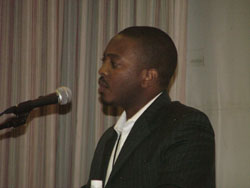
Biko spoke Monday to a packed
Taggart Student Center Auditorium as a part of
International Education Week. He is the founder
and executive director of the Steve Biko Foundation
and has done extensive work with the media as
a media consultant, published writer and international
speaker among other things.
"I have done this since
I was 15, and there was a point where I thought
I would stop lowering the microphone," Biko
said at the beginning of his lecture.
Biko said he was blessed with
both the challenge and honor of being Steve Biko's
son and felt it was necessary to share his father's
story out of a sense of moral responsibility as
well as to discuss the issue of protecting the
rights of people.
Biko began by telling his father's
story. He said his native South Africa is essentially
a country divided between races, the blacks and
the whites. His father, born into a normal family,
was 2 when the apartheid government, which separated
the races and took all political power away from
the black majority, took control. He was not interested
in politics until the age of 16. His older brother,
on the other hand, was politically active. It
was his arrest that aroused Steve's interest in
anti-apartheid politics. Steve was expelled from
school and blacklisted simply because his brother
was arrested for working against apartheid.
|
Who was Steve Biko?
Steve Biko has become a martyr and symbol
of black resistance to the oppressive apartheid
regime in South Africa.
Born in King William's Town, Eastern Cape,
South Africa, on Dec. 18, 1946, Biko became involved
in several political organizations working toward
social upliftment projects for disadvantaged black
communities and political prisoners.
He was "banned" by the apartheid
government in 1973 after helping to found the
Black Peoples Convention and restricted to his
hometown. He continued to work against apartheid,
becoming the Honorary President of the BPC in
1977.
Biko was detained and interrogated four times
between August 1975 and September 1977 under apartheid-era
anti-terrorism legislation.
On Aug. 21, 1977, Biko was detained by the
Eastern Cape security police and held in Port
Elizabeth, where he was kept chained and naked.
On Sept. 7, 1977, he suffered a head injury during
interrogation and died Sept. 12 as a result of
brain damage.
-- Loni Stapley
|
Steve became involved with the National Union of South
African Students while attending the University of Natal
Medical School, which he found to be dominated by whites.
"His observation while in this union was that
blacks were doing all the listening and the white people
were doing all the talking," Biko said.
In other words, black people were merely spectators,
not participators. And they were severely oppressed,
with laws such as the "72-hour rule" in effect,
meaning they could only be in "white" places
for 72 hours. Steve challenged black South Africans
to take a stand, believing they needed to learn to articulate
and speak up to make their lives better.
"The mind is the most powerful tool [in the
face of] oppression," Biko said.
Steve helped found the Black Peoples Convention in
1972, working on social upliftment projects. By 1973,
it had become the most powerful political force in South
Africa. Its success garnered attention from the apartheid
regime, leading to Steve's banishment, expulsion
from medical school and house arrest. Although Steve
could not be quoted or published at this time, he maintained
friendships with journalists, allowing the movement
to go forward.
Biko believes it was his father's "initiative
of unity" -- the idea of a united political force
against the apartheid regime -- in 1975 that led to
his eventual death. Steve was arrested and held in Port
Elizabeth, where he was kept chained and naked. Arrested
a healthy man, Steve died of a massive brain hemorrhage
sustained during interrogation on Sept. 12, 1977. He
was only 30.
"I lost my father at the age of 7," Biko
said. "He never saw me graduate -- or was a part
of any of the moments a young man or woman would want
[his or her] father to be a part of."
Biko said that although his father's death was tragic,
it was not the only one of its kind. Many black South
Africans died fighting against apartheid, with no one
taking responsibility for their deaths.
The apartheid regime lost power in 1994. Biko said
South Africa was one of the first countries to make
a relatively smooth transition from a history of violence
to peace and freedom. Some measures have been taken
to seek recompense for the families of the victims of
the brutality under the apartheid regime. The Truth
and Reconciliation Commission was created in 1995 by
the Government of National Unity to help deal with what
happened under apartheid. The Commission was set up
to investigate the nature and cause of human rights
violations and provide some sort of reconciliation to
the families.
Biko said that although the Commission has been somewhat
successful in bringing out the truth of what happened
under the apartheid regime, the reconciliation part
is trickier because it is a long-term process. For that
reason, Biko refers to the Commission only as the Truth
Commission because it is a "more accurate reflection
of what it's been able to achieve."
He said he and his family have seen no remorse for
what happened to his father -- there is a definite absence
of "owning up" for apartheid. The problem
stems from the fact that a lot of white South Africans
claim to have no knowledge of human rights violations
under the former government.
Biko said that 1994 was merely the beginning of the
end of apartheid. The effects of apartheid will not
disappear entirely anytime soon, but he believes eventually
his country will heal. Some want to pawn off the responsibility
of reconciliation to future generations, but Biko said
it needs to start now. It will just take work.
"The reality is -- that we have to roll up our
sleeves as young South Africans," Biko said. "We
as a nation have begun to cry a tear that has, for a
long time, refused to drop."
MS
MS
|